Treatment
Exercise therapy: what it is, who provides it, and when to use it
8 September 2026 · 9 min read
"Exercise therapist" isn't a recognised job title in Australia. Here's who prescribes exercise as treatment in Goulburn, what it treats and what a program involves.
What exercise therapy actually is
Exercise therapy is exercise used as a treatment. Not general fitness, and not "go to the gym and see how you go". A specific dose of movement, chosen for a specific problem, and progressed as you respond. The exercise is the treatment.
People search for an "exercise therapist" and often don't find one. That's because it isn't a recognised profession title in Australia. The main clinicians who prescribe exercise as treatment are physiotherapists and Accredited Exercise Physiologists. Both work from our Goulburn clinic, and both do this every day.
The idea is simple. Load a joint, a tendon or a heart in the right amount and it usually adapts. Too little and nothing changes; too much, too soon, and it flares. Getting that amount right for you is the whole job.
Dose, load and progression — why it isn't just "do more"
Think of it the way you'd think of medication: the type matters, and so does the dose. Here the dose is how hard, how much, how often and how quickly it steps up. Two people with the same knee can need very different starting points.
The starting point comes from assessment, not a template. We measure what you can currently handle, set the load a little under that, and build. The build is the treatment — a program that never progresses is just a warm-up.
- Type — strength, movement, balance or aerobic work, matched to the problem
- Load — how heavy, how far or how fast
- Volume — sets, reps and minutes in each session
- Frequency — sessions per week, in clinic and at home
- Progression — how much the load steps up, and what has to be true first
Conditions exercise therapy helps
Most current guidelines put exercise near the centre of treatment. That goes for a fresh injury after a short period of protection, and for a long-term condition. Where it sits depends on the problem.
For osteoarthritis, persistent back pain and tendon problems, exercise is the first treatment the evidence points to. It's usually tried before injections or surgery, and often you don't need a scan first.
After surgery, and for heart, lung and metabolic conditions, it works differently. It's a core part of treatment, alongside the plan from your surgeon, GP or specialist — not a replacement for it. Our knee osteoarthritis and chronic pain pages cover two conditions we see often in Goulburn.
Who provides exercise as treatment in Goulburn
Mainly two professions. Physios often see the fresh injury first; exercise physiologists often lead longer recoveries and chronic-condition programs, and many people see both. Either way, at our Goulburn clinic it starts with an assessment. Our article on what an exercise physiologist does covers which one to start with.
Where exercise rehabilitation happens: clinic gym, pool and home
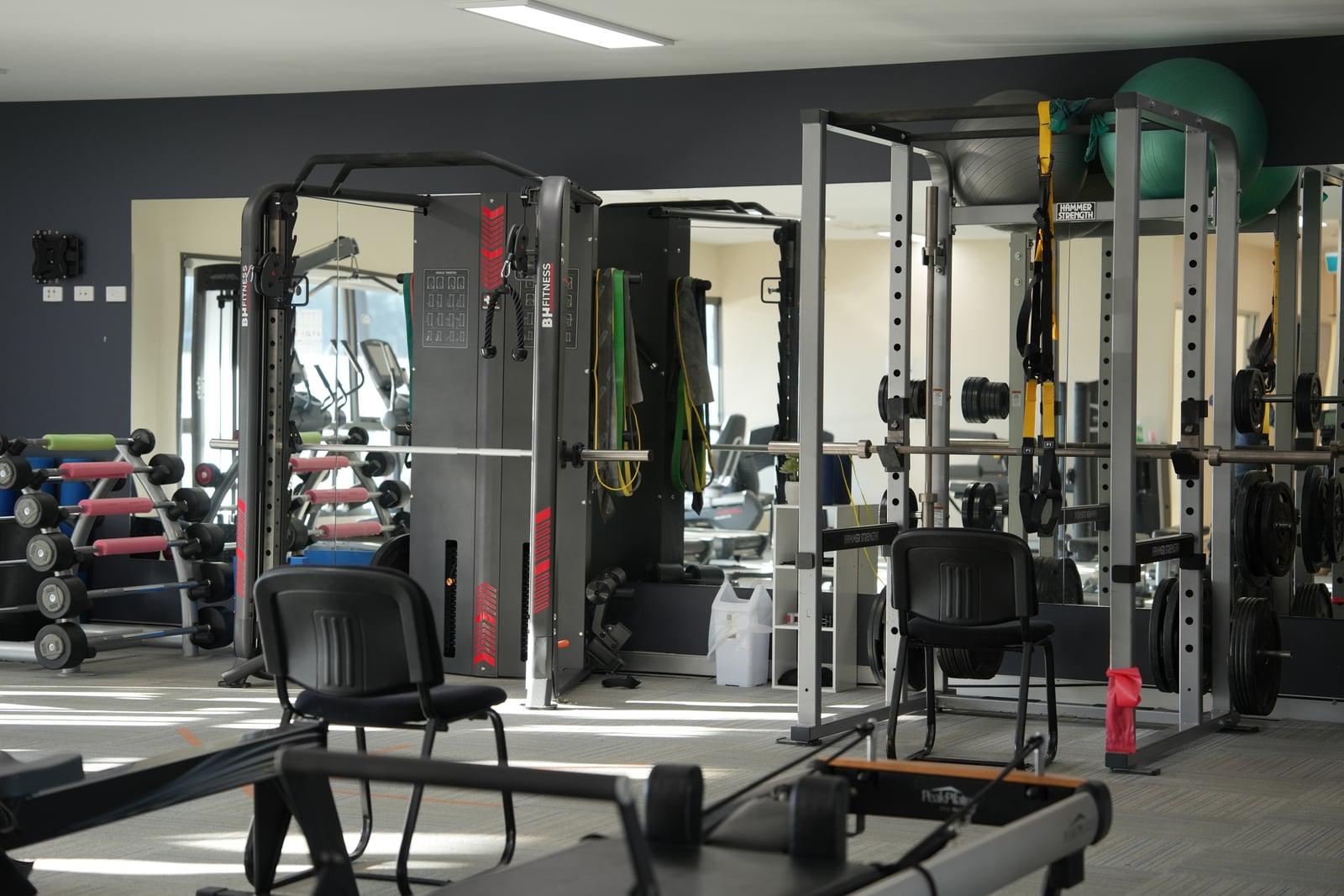
Most exercise rehabilitation at our Goulburn clinic happens in the clinical gym — reformer, dumbbells, cable machines, cardio machines, floor space. It's set up for graded loading, not for a workout. Some programs start from a chair.
Sometimes loading on land is still too sore — a flared back, severe arthritis, a new hip. Hydrotherapy moves the same program into warm water instead. After surgery, the pool waits until the wound has healed and your surgeon is happy.
Buoyancy takes most of your body weight off the joint, so you can load it earlier. The first hydrotherapy appointment is on land, where the physio decides whether the pool is the right start.
The home program does most of the work. Clinic sessions set the dose and check technique; the repetitions between visits are where the tissue adapts. A few exercises done properly beat a long list done badly.
What the first session and a typical program look like
At our Goulburn clinic, the first appointment is an assessment, not a workout. We take the history — what's going on, what you need to get back to, other conditions. We also read anything your GP, specialist or surgeon has sent. After a recent heart event or surgery, we check with them before stepping the load up. If you're using NDIS funding, bring your plan and goals, and your plan manager's details if you're plan-managed.
Then we measure. Strength, range, balance, how far you can go before symptoms change — whichever numbers matter for your problem. Those numbers set the starting dose, and we re-test them later to see whether it's working. You'll usually start the program in the same visit.
A typical program runs in blocks, with a review at the end of each. Load steps up when the markers say it should, not on a calendar. Supervised sessions are usually more frequent early and taper to mostly home work with check-ins. Reports go to your GP, surgeon, case manager or insurer when the pathway needs them, and support your NDIS plan review.
How exercise therapy is funded in Goulburn
At our Goulburn clinic, physio and exercise physiology can be funded through Medicare, private health extras, WorkCover, CTP, DVA or the NDIS. For Medicare rebates, your GP decides if you qualify for a Chronic Disease Management (CDM, formerly EPC) plan. NDIS funding typically sits under Capacity Building, for therapy related to your disability and tied to your plan goals. Not every service runs under every scheme — hydrotherapy isn't offered under WorkCover or CTP. Our NDIS, WorkCover and CTP exercise physiology pages explain how each one works.
Why exercise matters more than passive treatment alone
Hands-on treatment, massage, heat, taping and needling can all ease symptoms, and we use them. On their own, they're less likely to change what the tissue can tolerate. That usually takes load. The evidence broadly agrees: passive treatment alone tends to give short-term relief, and graded exercise is what guidelines recommend for the longer term.
So exercise as treatment isn't "exercise instead of treatment". It's exercise as the treatment, with hands-on work used to make the exercise possible sooner. If you're not sure where to start, book an assessment at our Goulburn clinic and we'll set the starting dose from there.
Red flags — when to stop and get it checked
Prescribed exercise is safe for most people, including most with heart, lung or metabolic conditions — that's why it gets prescribed. Muscle soreness for a day or two is normal early in a program. A flare in the problem area that hasn't settled by the next morning is a dose question — tell us and we adjust it.
The warning signs below are different. Some can mean a heart attack or stroke, and all need medical care before the program continues.
A few need an extra step. If you have an angina action plan, follow it, and call 000 if symptoms are severe, get worse or last more than 10 minutes. If someone collapses and isn't breathing normally, start CPR. If someone with diabetes becomes drowsy, can't swallow safely, is unconscious or has a seizure, call 000 and give nothing by mouth. Your GP or pharmacist can tell you how your medicines interact with exercise.
- Chest pain, pressure, heaviness or tightness, which may spread to your arm, jaw, neck, shoulder or back, especially with a cold sweat, nausea, dizziness or breathlessness — stop and call 000
- Sudden, unexplained breathlessness or chest pain after surgery — call 000
- Fainting or collapsing during exercise — call 000
- Feeling faint, or a new racing or irregular heartbeat — stop for the session, then same-day GP if it settles with rest, or ED if it doesn't
- Sudden numbness or weakness (especially down one side of the body), a drooping face, slurred or confused speech, trouble understanding, sudden vision loss or a sudden severe headache — call 000, even if it settles
- New numbness, tingling or weakness in an arm or leg that has come on over hours or days — see your GP or go to ED the same day
- Numbness around the groin, buttocks or inner thighs, new trouble passing or controlling urine or bowels, or weakness in both legs — go to ED now
- A hot, swollen or painful calf after surgery — same-day GP or ED
- A surgical wound that turns red, hot, swollen or weeping, or a fever after surgery — contact your surgeon or GP the same day, or go to ED
- A joint that suddenly swells, locks or gives way — same-day GP or ED, or straight to ED if it's also hot and red or you have a fever
- A sudden pop or sharp pain in a tendon during exercise, followed by weakness (for example, you can't push up onto your toes) — stop and get it checked the same day at your GP or ED
- Diabetes, and you feel shaky, sweaty or confused during or after exercise — stop, follow your hypo plan and let us know
- Back pain with fever, unexplained weight loss, or constant pain at night that doesn't ease with position — see your GP promptly
- A recent heart event or surgery — clearance from your GP, cardiologist or surgeon before the load steps up, as covered above under the first appointment
Where this fits
Services that help with this.
Keep reading